Order Enquiries (UK) : 01436 820269

You currently have no items in your basket


Buy with confidence and security!
Publishing historical art since 1985

Don't Miss Any Special Deals - Sign Up To Our Newsletter!
Aircraft
Search
Squadron
Search
Signature
Index
Artist
Index
SPECIAL OFFERS
Product Search         
CLICK HERE FOR A FULL LIST OF ALL PHILIP WEST PRINTS BY TITLE
ALWAYS GREAT OFFERS :
20% FURTHER PRICE REDUCTIONS ON HUNDREDS OF LIMITED EDITION ART PRINTS
BUY ONE GET ONE HALF PRICE ON THOUSANDS OF PAINTINGS AND PRINTS
FOR MORE OFFERS SIGN UP TO OUR FREE NEWSLETTER

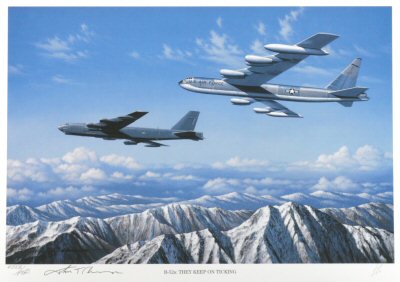
B-52s: They Keep on Ticking by Stan Stokes.- Philip West Prints .com
THIS ITEM IS INCLUDED IN OUR BUY ONE GET ONE HALF PRICE OFFER !
Choose any two prints in this special offer and the lower priced item is half price. (Any free bonus prints already supplied with an item are separate and will also be included !)
Hundreds of items across our websites are included in this offer!

B-52s: They Keep on Ticking by Stan Stokes.


B-52s: They Keep on Ticking by Stan Stokes.

The Boeing B-52 Stratofortress has played a major role in Americas defense for nearly forty years. In his dramatic painting appropriately entitled B-52s: They Keep On Ticking, aviation artist Stan Stokes depicts an early big-tailed B-52B and a more contemporary B-52G which saw service during Operation Desert Storm. The origins of the development of the B-52 begins way back in the early 1940s. All major aircraft companies were interested in developing the first truly intercontinental bomber. Shortly after WW II the Convair XB-36 and the Northrop XB-35 were developed, and both had intercontinental range. However, neither of these aircraft were capable of penetrating deep into Soviet airspace, and defense planners in the early 1950s presumed that the Soviets would be our prime adversaries for years to come. In 1946 the Air Force issued a requirement for its next generation of strategic bombers. Required was a range of at least 5,000 miles with a minimum 10,000 pound bomb load, a top speed in excess of 450 MPH and an operational ceiling of at least 40,000 feet. Boeing entered this competition with the XB-52 which incorporated six turboprop engines. Part way into prototype development, Boeings designers decided to scrap this design in favor of a swept wing jet powered aircraft. The first XB-52 was rolled out in November of 1951. One major change in the prototype was a complete redesign of the forward fuselage to allow the pilots to sit side-by-side. The B-52B was the first true production model of the Stratofortress. It became operational in 1955 with the Strategic Air Command. On January 16, 1957 SAC demonstrated the amazing capabilities of the B-52 with a non-stop around the world flight covering over 24,000 miles in 45 hours and 19 minutes. The B-52B was phased out in the mid 1960s. The B-52C was the first of these aircraft to be painted gloss white on its entire underside to reflect the heat from nuclear blasts. The C remained in service until 1971. The B-52D saw significant service in Vietnam. Many of these models were modified to carry up to as many as 108 conventional bombs. During a major offensive strike at Hanoi in December 1972 a total of 729 B-52 sorties were flown. Only 15 aircraft were lost, despite the fact that Hanoi was heavily protected with SAMs and anti-aircraft batteries. The B-52G was the first of the short tail models. The manned rear gun turret was removed on these models, and the fuel capacity was significantly increased. The G model was the first of the B-52s to carry cruise missiles, a development which significantly lengthened the useful service life of this aircraft. The B-52G is, like its predecessors, a very large aircraft with a wingspan in excess of 185 feet, and a maximum take off weight of 488,000 pounds. With a range in excess of 7,000 miles and a maximum speed of 634 MPH, the Gs were successfully utilized in the Gulf War, and no doubt will continue to see service for many more years into the future. The B-52 is clearly one of the most unique of all post-WW II military aircraft, and it is interesting to note that it is one of only a very few aircraft designs which is older than most of the pilots who fly it.
Item Code : STK0045B-52s: They Keep on Ticking by Stan Stokes. - This EditionAdd any two items on this offer to your basket, and the lower priced item will be half price in the checkout! Buy 1 Get 1 Half Price!
TYPEEDITION DETAILSSIZESIGNATURESOFFERSYOUR PRICEPURCHASING
PRINT Signed limited edition of 4750 prints.

Supplied with signed and numbered certificate of authenticity.
Print size 16 inches x 11.5 inches (41cm x 30cm) Artist : Stan Stokes£15 Off!Now : £35.00

Quantity:
All prices on our website are displayed in British Pounds Sterling


Other editions of this item : B-52s: They Keep on Ticking by Stan Stokes. STK0045
TYPEEDITION DETAILSSIZESIGNATURESOFFERSYOUR PRICEPURCHASING
PRINT 225 prints from the signed limited edition of 4750 prints, with signature of Stan Stokes and pilot, and a remarque.Image size 16 inches x 11.5 inches (41cm x 30cm) Chain, John T
+ Artist : Stan Stokes


Signature(s) value alone : £45
£10 Off!Now : £110.00VIEW EDITION...
PRINT Limited edition of 100 giclee art prints.

Only one print remains of this sold out edition.
Size 21 inches x 14 inches (53cm x 36cm)Artist : Stan Stokes£145.00VIEW EDITION...
PRINTPrints from the 225 prints from the signed limited edition of 4750 prints, with signature of Stan Stokes and pilot. Image size 16 inches x 11.5 inches (41cm x 30cm) Chain, John T
+ Artist : Stan Stokes


Signature(s) value alone : £45
£25 Off!Now : £75.00VIEW EDITION...
General descriptions of types of editions :

Extra Details : B-52s: They Keep on Ticking by Stan Stokes.
About all editions :

A photograph of an edition of the print :

The Aircraft :
NameInfo
StratofortressThe Boeing B-52 Stratofortress has played a major role in Americas defense for nearly forty years. In his dramatic painting appropriately entitled B-52s: They Keep On Ticking, aviation artist Stan Stokes depicts an early big-tailed B-52B and a more contemporary B-52G which saw service during Operation Desert Storm. The origins of the development of the B-52 begins way back in the early 1940s. All major aircraft companies were interested in developing the first truly intercontinental bomber. Shortly after WW II the Convair XB-36 and the Northrop XB-35 were developed, and both had intercontinental range. However, neither of these aircraft were capable of penetrating deep into Soviet airspace, and defense planners in the early 1950s presumed that the Soviets would be our prime adversaries for years to come. In 1946 the Air Force issued a requirement for its next generation of strategic bombers. Required was a range of at least 5,000 miles with a minimum 10,000 pound bomb load, a top speed in excess of 450 MPH and an operational ceiling of at least 40,000 feet. Boeing entered this competition with the XB-52 which incorporated six turboprop engines. Part way into prototype development, Boeings designers decided to scrap this design in favor of a swept wing jet powered aircraft. The first XB-52 was rolled out in November of 1951. One major change in the prototype was a complete redesign of the forward fuselage to allow the pilots to sit side-by-side. The B-52B was the first true production model of the Stratofortress. It became operational in 1955 with the Strategic Air Command. On January 16, 1957 SAC demonstrated the amazing capabilities of the B-52 with a non-stop around the world flight covering over 24,000 miles in 45 hours and 19 minutes. The B-52B was phased out in the mid 1960s. The B-52C was the first of these aircraft to be painted gloss white on its entire underside to reflect the heat from nuclear blasts. The C remained in service until 1971. The B-52D saw significant service in Vietnam. Many of these models were modified to carry up to as many as 108 conventional bombs. During a major offensive strike at Hanoi in December 1972 a total of 729 B-52 sorties were flown. Only 15 aircraft were lost, despite the fact that Hanoi was heavily protected with SAMs and anti-aircraft batteries. The B-52G was the first of the short tail models. The manned rear gun turret was removed on these models, and the fuel capacity was significantly increased. The G model was the first of the B-52s to carry cruise missiles, a development which significantly lengthened the useful service life of this aircraft. The B-52G is, like its predecessors, a very large aircraft with a wingspan in excess of 185 feet, and a maximum take off weight of 488,000 pounds. With a range in excess of 7,000 miles and a maximum speed of 634 MPH, the Gs were successfully utilized in the Gulf War, and no doubt will continue to see service for many more years into the future. The B-52 is clearly one of the most unique of all post-WW II military aircraft, and it is interesting to note that it is one of only a very few aircraft designs which is older than most of the pilots who fly it.

Contact Details
Shipping Info
Terms and Conditions
Cookie Policy
Privacy Policy

Join us on Facebook!

Sign Up To Our Newsletter!

Stay up to date with all our latest offers, deals and events as well as new releases and exclusive subscriber content!

This website is owned by Cranston Fine Arts.  Torwood House, Torwoodhill Road, Rhu, Helensburgh, Scotland, G848LE

Contact: Tel: (+44) (0) 1436 820269.  Email: cranstonorders -at- outlook.com

Follow us on Twitter!

Return to Home Page