|
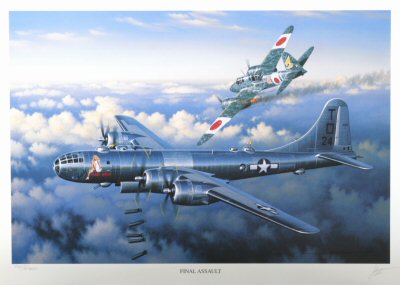
Final Assault by Stan Stokes. (B)
The largest and most powerful bomber of WW II, the Boeing B-29 Super Fortress, played a major role in bringing about the defeat of Japan. In addition to accelerating Japans surrender following the bombing of Hiroshima and Nagasaki with atomic bombs, thousands of B-29 crews flew tens of thousands of bombing missions against Japan from bases in China, India, and later in the War from recaptured islands in the Pacific. B-29s entered service in 1943 following a lengthy, problem-filled, development process of three years in response to the governments request for a long range strategic bomber. Only Boeing and Douglas (the B-32 Dominator) responded to the governments requests, and the B-32 had even greater development problems than the B-29. Powered by four giant Wright R-3350-23 radial engines generating a total horsepower of 8,924, the Super Fortresses typically carried crews of ten. They were capable of a top speed of 357-MPH, and at slower cruising speeds had a range of more than 3,200 miles. The B-29 was a large aircraft for its time with a wingspan in excess of 140 feet and a length of just under 100 feet. The Super Forts also had pressurized forward and aft hulls, which made the long distance missions a bit more comfortable for the flight crews. B-29s typically carried defensive armament which included ten machine guns and a single tail-mounted canon. Because of the pressurized hull, the guns were operated by remote control. The first operational B-29 wing was the 58th which flew out of the China-Burma-India theater. On March 9, 1945 General Curtis LeMay ordered an unusual low altitude attack on Tokyo by hundreds of B-29s carrying incendiary bombs. Five such low level missions were scheduled over a ten-day period, and the combined destruction of these missions exceeded that of either of the atomic bomb missions. B-29s were also effectively used to mine Japanese ports and shipping lanes. The Kawasaki Ki-45 Toryu heavy fighter, which is depicted attacking the B-29 in Stan Stokes painting, entered production in 1941 following a lengthy four year development. About 1,700 of these aircraft, code named Nick by the allies, were produced. The Ki-45 never proved effective as a long range daylight interceptor. It was, however, used effectively in ground attack and night fighter roles. It was one of only a few Japanese aircraft that had some success against the onslaught of B-29s because it was able to attain the high altitudes necessary to intercept the high-flying Super Fortresses. This print is dedicated to the thousands of B-29 officers and crewmen who hastened the end of the Pacific War. |
| | Item Code : STK0093B | Final Assault by Stan Stokes. (B) - This Edition | |
| | TYPE | EDITION DETAILS | SIZE | SIGNATURES | OFFERS | YOUR PRICE | PURCHASING | | PRINT | Limited edition of 25 giclee art prints.
Just two of this print edition now available. | Size 21 inches x 14 inches (53cm x 36cm) | Artist : Stan Stokes | | £145.00 |
|
| All prices on our website are displayed in British Pounds Sterling |
|
|