|
|
|
|
|
|
|
|

|
Don't Miss Any Special Deals - Sign Up To Our Newsletter!
|
|||||||||||||||
| CLICK HERE FOR A FULL LIST OF ALL PHILIP WEST PRINTS BY TITLE |
|
| |||||||||||||||||||||||||||||
| Signatures on this item | |
| *The value given for each signature has been calculated by us based on the historical significance and rarity of the signature. Values of many pilot signatures have risen in recent years and will likely continue to rise as they become more and more rare. | |
| Name | Info |
 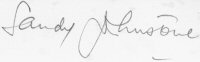 Air Vice Marshal Sandy Johnstone CB DFC AE DL (deceased) *Signature Value : £60 | Early in 1938, Alexander Vallance Riddell Johnstone, known as Sandy, was a civilian navigation instructor at Scottish Aviation, moving later to the Civil Air Navigation School at Prestwick. In August 1939 he was called to full-time service with 602 Squadron. After some Spitfire engagements off the Scottish coast, he received command of 602 - he was still only 24 - and led it south to the tiny airfield at West Hampnett, in West Sussex, where it was stationed throughout the Battle of Britain. Sandy was in command of no. 602 squadron during the critical days of the Battle of Britain, flying with the squadron before the war though to 1941, when he was posted to the Middle east, he also served with 229 and 249 squadrons in Malta during the Islands most fateful days of the war. Sandy became a successful author and resided near Ipswich in Suffolk. Sandy Johnstone died 13th December 2000, aged 84. |
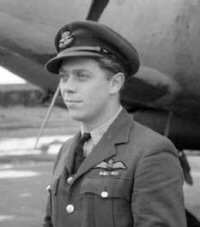 Air Vice-Marshal Frederick Desmond Hughes (deceased) *Signature Value : £60 (matted) | Hughes learned to fly with the University Air Squadron before receiving a direct-entry commission into the RAF in 1939. After completing his pilot training, he joined No. 264 Squadron, flying the Defiant during the Battle of Britain and later in night-fighter operations, where he achieved numerous aerial victories alongside his gunner, Sergeant F. Gash, earning the Distinguished Flying Cross (DFC) in 1941. As a flight commander with No. 125 and later No. 600 Squadron in North Africa, he continued his success against enemy aircraft, receiving two Bars to his DFC for outstanding combat achievements. Returning to Britain in 1944, Hughes commanded No. 604 Squadron during the Allied advance in Europe, claiming further victories before being awarded the Distinguished Service Order (DSO) in 1945. Remaining in the RAF after the war, he held a series of senior staff and command appointments, including Commandant of RAF College Cranwell, where he oversaw the Prince of Wales's flying training. His distinguished post-war service was recognised with the Air Force Cross (AFC), appointment as Commander of the Order of the British Empire (CBE), and Companion of the Order of the Bath (CB). Hughes retired in 1974 as an Air Vice-Marshal, and died on the 11th of January 1992. |
  Wing Commander Peter Parrott DFC AFC (deceased) *Signature Value : £75 | Born 28th of June 1920, Peter Parrott joined the RAF in 1938, completing his fighter pilot training before joining No.607 Sqn in early 1940. On the 10th of May 1940, he destroyed two He111s and damaged a further two, sharing in another the next day. He was then posted to No.145 Sqn, damaging a Bf110 on May the 22nd and an He111 four days later, an action which saw his aircraft sufficiently damaged to force him to crash land in Kent. During the Battle of Britain, Peter Parrott destroyed a Me109, Ju87, Ju88 and damaged an He111, before being posted to No.605 Sqn in September. After baling out of his damaged Hurricane in December 1940 and remaining with 605 Sqn until summer 1941, he became an instructor. From July 1943 he joined a number of Squadrons in Italy, returning to Britain after the war to become a test pilot. He died 27th August 2003. |
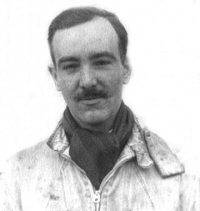 Wing Commander Ronald Brown (deceased) *Signature Value : £60 | Brown joined the RAF as an Aircraft Apprentice in 1929, qualifying as an engine fitter before being selected for pilot training in 1935. After earning his wings in 1936, he joined No. 111 Squadron, becoming one of its first pilots to fly the newly introduced Hurricane fighter. During the Battle of France and the Dunkirk campaign he flew regular combat patrols, claiming a probable enemy aircraft before being shot down over France in June 1940. After recovering from his injuries, he returned to active service during the Battle of Britain, contributing to the destruction and damaging of several German aircraft. Commissioned later that year, Brown went on to instruct new pilots and subsequently served at the Air Fighting Development Unit, where he tested a variety of British, American and captured enemy aircraft. In 1941 he transferred to the RAF Engineering Branch, playing an important role in aircraft development, including work on the Martin-Baker ejection seat. He retired from the RAF in 1947 as a Squadron Leader, retaining the rank of Wing Commander, he died on 9th November 2003. |
|
Contact Details |
|
Sign Up To Our Newsletter!
This website is owned by Cranston Fine Arts. Torwood House, Torwoodhill Road, Rhu, Helensburgh, Scotland, G848LE Contact: Tel: (+44) (0) 1436 820269. Email: cranstonorders -at- outlook.com |
 |


