
 |
Overdue by Gerald Coulson.
The Vickers-Armstrong Wellington entered service life in the RAF in 1938 as a medium bomber. As the mainstay of the Bomber Command, it bore the initial brunt of the RAFs night offensive during 1940. Without the benefit of sophisticated navigation aids, the bomber crews had difficulty locating and hitting targets and also contending with rapidly improving German defences. The picture depicts an incident at sunrise on the morning of 26th July 1940. A Wellington 1c of 99 Squadron, based at Newmarket Heath, returns from a raid over Dortmund. An engine fails over the North Sea and the aircraft, captained by Squadron Leader Sarll, struggled almost to its home base and crashed just south of Cambridge. The crew survived. |
| | Item Code : GC0187 | Overdue by Gerald Coulson. - This Edition | |
| | TYPE | EDITION DETAILS | SIZE | SIGNATURES | OFFERS | YOUR PRICE | PURCHASING | | PRINT | Signed limited edition of 850 prints.
| Image size 26 inches x 20 inches (66cm x 51cm) | Artist : Gerald Coulson | £50 Off! | Now : £150.00 |
|
| Extra Details : Overdue by Gerald Coulson. | | About all editions : | 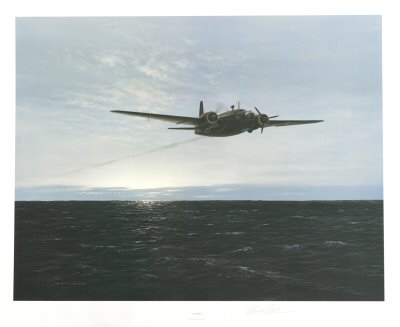
A photo of the print.
|
|
|
|
|
| The Aircraft : | | Name | Info | | Wellington | The Vickers Wellington was a Bomber aircraft and also used for maritime reconnaissance. and had a normal crew of six except in the MKV and VI where a crew of three was used. Maximum speed was 235 mph (MK1c) 255 mph (MK III, X) and 299 mph (MK IIII), normal operating range of 1805 miles (except MK III which was 1470miles) The Wellington or Wimpy as it was known, was the major bomber of the Royal Air Force between 1939 and 1943. The Royal Air Force received its first Wellingtons in October 1938 to 99 squadron. and by the outbreak of World war two there were 6 squadrons equipped with the Vickers Wellington. Due to heavy losses on daylight raids, the Wellington became a night bomber and from 1940 was also used as a long range bomber in North Africa. and in 1942 also became a long range bomber for the royal Air Force in India. It was well used by Coastal Command as a U-Boat Hunter. The Wellington remained in service with the Royal Air Force until 1953. Probably due to its versatile use, The aircraft was also used for experimental work including the fitting of a pressure cabin for High altitude tests. The Vickers Wellington could sustain major damage and still fly, probably due to its construction of its geodesic structure and practical application of geodesic lines. Designed by Sir Barnes Wallis |
|



